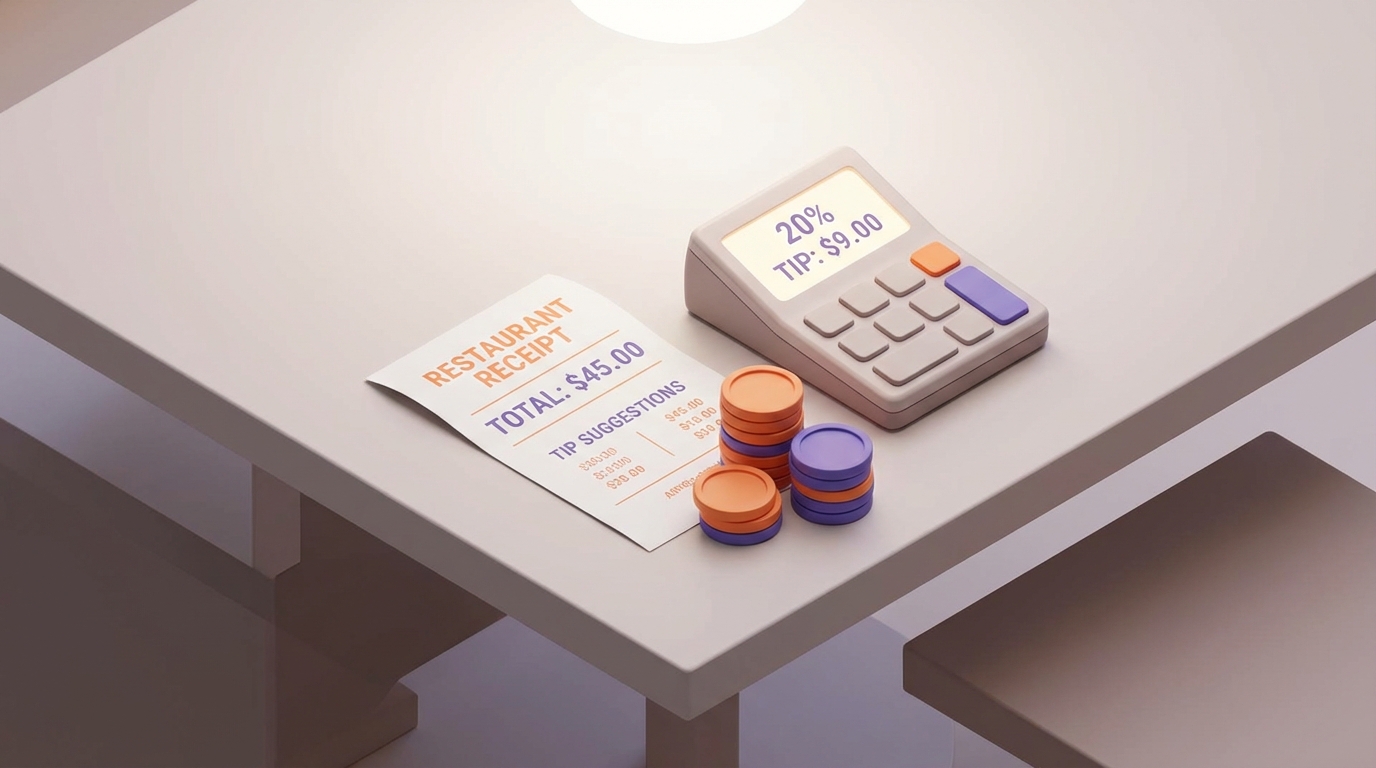
The dinner has ended, everyone has had a great time, and the server drops the leather checkbook on the table. Suddenly, unless someone in the group is a math whiz, a momentary wave of panic hits. How much was the tax? Are we tipping on the pre-tax or post-tax amount? If the bill is $142.68, what is 20%?
Calculating a tip shouldn't require a college degree, but it often feels like it. In this quick guide, we'll show you the simplest mental math tricks to calculate a tip instantly, the standard rules of dining etiquette, and how to effortlessly split a complicated bill.
Just use our Free Tip Calculator. Enter the bill amount, choose your percentage, and it instantly spits out the exact tip, totally bill, and how much each person owes if you are splitting it.
The 10% Trick: How to calculate a tip in your head
If your phone is dead and you need to figure out a 15% or 20% tip instantly, the easiest method is to find 10% first.
Finding 10% is just moving the decimal
If your bill is $84.50, simply move the decimal point one spot to the left.
Your 10% amount is exactly $8.45.
Once you have your 10% number, everything else is basic addition:
- To tip 20%: Take your 10% number and double it. ($8.45 × 2 = $16.90)
- To tip 15%: Take your 10% number, cut it in half, and add those two together. ($8.45 + $4.22 = $12.67)
- To tip 18%: Calculate your 20% tip, and subtract a couple of dollars.
Tipping Etiquette: Pre-tax or Post-tax?
This is the most hotly debated question in modern dining: do you calculate your 20% on the subtotal (the actual cost of the food and drinks) or the final total (which includes state and local taxes)?
According to traditional etiquette experts (like the Emily Post Institute), you tip on the pre-tax amount. You are tipping for the service provided on the items you ordered; there is no logic in giving the server a percentage of the money the state government is taking from you.
However, in modern practice, nearly everyone (and every automated point-of-sale tablet you are handed at a counter) calculates the tip on the final, post-tax total simply because it is the biggest, easiest number to see at the bottom of the receipt. If you are calculating the tip by hand, tipping pre-tax is highly acceptable and historically correct.
The Nightmare of Splitting the Bill
"Just split it evenly" works perfectly when five people order burgers and beers. It is a disaster when one person ordered a side salad and water, and someone else ordered a ribeye steak and three cocktails.
Here are the rules for splitting:
- The Even Split: The easiest way. Total Bill + 20% Tip = Grand Total. Divide the Grand Total by the number of people. (Our Tip Calculator does this instantly).
- The Itemized Split: One person pays the whole bill on their credit card. Everyone else Venmos or Zelles that person for their exact items, plus their portion of the tax and tip. (If you bought a $20 steak, do not just Venmo your friend $20. You owe them $20 + Tax + Tip, which is usually around $26).
Stop Doing Table Math
Use our free tool to instantly calculate, split, and round out your tipping math.
Open Tip CalculatorFrequently Asked Questions
What is the standard tipping percentage today?
In the United States, 15% to 20% remains the gold standard for sit-down, full-service dining. For phenomenal service, 22% or higher is appreciated. Counter service (coffee shops, bakeries) does not require a percentage tip, though dropping a dollar in the jar is polite.
Should I tip on takeout orders?
Traditional etiquette says no; a tip is explicitly for the extended table service of a waiter. However, a modern compromise is tossing 5% to 10% on a takeout order to thank the staff for securely packaging the food and checking the order accuracy.
What if a service charge is already included?
If a restaurant adds an "18% auto-gratuity" to your bill (common for parties of 6 or more), that is the tip. You are under no obligation to add an additional tip on top of that, although the receipt will usually still print a blank "Additional Tip" line due to software limitations.